Breed Society Rules
At its inception the objective for the Belmont was to blend an average of the genes from the Africander and from the British. Adaptive traits such as easy calving, parasite resistance, disease resistance, heat tolerance and hardiness, as well as meat quality traits and fertility were inherited from the Africander. Productive traits, such as fertility and growth, as well as carcase and meat quality were also inherited from the British. Genetically the Africander component distinguishes the Belmont from other Composite breeds based on the Brahman such as Santa Gertrudis, Droughtmaster, Brangus, Charbray and Braford.
The range and combinations of established breeds included in the Belmont provided it with all the desirable traits of the British, European and other Tropical breeds. The herd book remains open and grading up to pure Belmont can simply be accomplished in three back crosses. The Belmont can therefore be established by simply grading up from any base cow herd through three generations of mating to registered Belmont bulls, the fourth crop being registrable as pure Belmonts. This allows the Belmont Breeders to tap into a broad genetic base and retain desirable gene combinations from the parent breeds. With the correct selection programmes, the productive desirable gene combinations can be accumulated and fixed.
Performance
Growth, fertility, carcase yield, meat quality.
Adaptive
Parasite and disease resistance, ease of calving, heat and drought tolerance.Management
Temperament, polled.Structural
Soundness
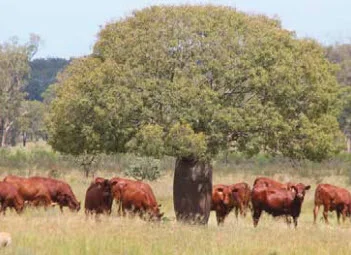
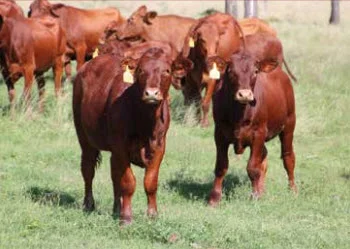
The Belmont Breed Society has based its standards on productive and adaptive traits that can be objectively measured and are known to be heritable. Selection is therefore based on accurate measurements of traits that are heritable and economically important in terms of beef production Any Belmont animal must therefore be reared in a herd which has adopted a system of performance recording that has been approved by Council, such as Breedplan.
Although the colour is predominantly red, selection for this, or other aesthetic traits are generally not considered important. The Belmont is about a philosophy of breeding highly productive, easy care cattle, that are adapted to their environment. In this respect the Belmont differs significantly from ALL other breeds. The Belmont Breed Society regulations specify the following breed (genetic) content:
- African Sanga breeds (Africander or similar) - max.1/2, min 1/4:
- Temperate breeds (British or European) - max. 1/2, min. 1/2.
- Indicus breeds (Brahman or similar) - max 1/4: